Wednesday, July 20, 2011

Seroquel VI: The FDA Finale

 Written By: 1 Boring Old Man

Posted on Saturday 12 February 2011

We all know how the F.D.A. Approval comes out. Seroquel was approved in September of 1997 and turned into a megablockbuster for AstraZeneca and for the Patients [and their Lawyers] who sued [and will continue to sue] them. But let’s continue to look carefully at Trial 0013, the one that brought the approval home for then Zeneca Pharmaceuticals.
I had known about Trial 0015 from reading those subpoenaed documents released in 2009, but I hadn’t known where it fit in the approval story. So when I first started looking at Trial 0013, because of the similarities in the protocols, I wondered if it wasn’t just a piece of Trial 0015 that they plucked out [the raw data is not available]. Were they pulling a fast one? That’s what sent me back going through the F.D.A. documents until I found it submitted with their approval package [see seroquel V: through the looking glass…]. It was a discrete study published in Biological Psychiatry:
Multiple Fixed Doses of "Seroquel" (Quietiapine) in Patients with Acute Exacerbation of Schizophrenia: A Comparison with Haloperidol and Placebo
by Lisa A. Arvanitis, Barbara G. Miller, and the Seroquel Trial 13 Study Group
BIOL PSYCHIATRY 1997;42:233-246

Five fixed doses of the atypical antipsychotic "Seroquel" (quetiapine) were evaluated to delineate a dose-response relationship, as measured by changes from baseline in Brief Psychiatric Rating Scale (BPRS), Clinical Global Impression (CGI), and Modified Scale for the Assessment of Negative Symptoms (SANS) summary scores, and to compare efficacy and tolerability opposite placebo and haloperidol. Three hundred sixty-one patients from 26 North American centers entered this double-blind, placebo-controlled trial with acute exacerbation of chronic schizophrenia (DSM-III-R). Patients who completed a single-blind, placebo washout phase were randomized to double-blind treatment with quetiapine (75, 150, 300, 600, or 750 mg daily), haloperidol (12 mg daily), or placebo and evaluated weekly for 6 weeks. At end point, significant differences (p < 0.05, analysis of covariance) in adjusted mean changes from baseline were identified between the four highest doses of quetiapine and placebo for BPRS total, BPRS positive-symptom cluster, and CGI Severity of Illness item scores and between quetiapine 300 mg and placebo for SANS summary score. Differences between quetiapine and haloperidol were not significant. Dose-response modeling showed significant linear and quadratic functions of quetiapine dose for all primary efficacy variables. Notably, no significant safety concerns were identified as dose increased. Quetiapine was no different from placebo across the dose range studied regarding incidence of extrapyramidal symptoms or change in prolactin concentrations. Quetiapine is well tolerated and clinically effective in the treatment of schizophrenia. It is both superior to placebo and comparable to haloperidol in reducing positive symptoms at doses ranging from 150 to 750 mg/day and in reducing negative symptoms at a dose of 300 mg/day. [Received August 14, 1996; revised March 18, 1997.]
Here are the F.D.A. Report’s comments and some of the data:
    "This Phase III trial randomized a total of 361 patients among 26 in the US and Canada to 5 fixed doses of Seroquel (75 mg N=53, 150 mg N=48, 300 mg N=52, 600 mg N=51, 750 mg N=54) or 12 mg haloperidol (N=52) or placebo (N=51). The target sample size of 50/arm resulted from simulations of various dose-response models using a power of 90%."
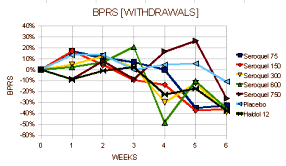
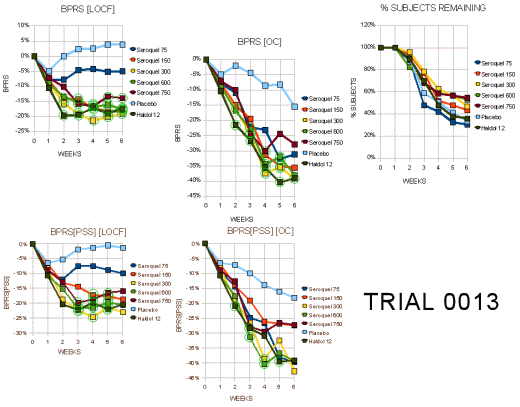
Lots and lots of green circles on this study. But before we get to that, look at the Haldol response. Haldol appears to be the gold standard in this study, usually surpassing that of Seroquel at any dose. We knew that from Trial 0015, though that study wasn’t considered by the F.D.A. apparently. They chose a fairly brisk dose of Haldol which probably explains the fact that the Haldol had the largest drop-out rate of any group [my guess - side effects]. But we know from Trial 0015 that’s not the case long-term [seroquel V: through the looking glass…]. This study is actually an example of one of the things wrong with the LOCF method. In the placebo and low dose Seroquel groups, the drop-outs are likely a function of worsening untreated disease. In the Haldol group, the drop-outs are probably from side effects. Such push-pull effects make the results confusing [eg the "last observed" at withdrawal curves].  In the report, the reviewers said:
    "Withdrawal rates ranged from 50%-70% with the highest in the placebo, 75 mg and haloperidol groups. Tables 16a and 16b display the visit-wise results of the total BPRS for the LOCF and observed cases analyses, respectively. All but the 75 mg/day dose of Seroquel were statistically significantly different from placebo for the LOCF analysis, whereas none were significant in the completers analysis… Tables 18a and 18b display the results of the key positive symptom BPRS cluster for the LOCF and observed cases, respectively. This endpoint shows a similar profile of a nearly significant LOCF analysis and a null completers analysis."
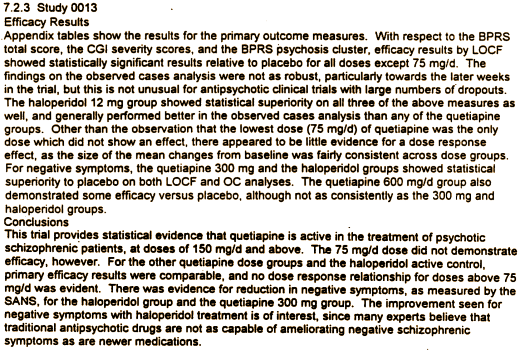
In spite of all the green circles [significant values], at the end, the BPRS was not significant in the OC [completers] graph, and in neither the LOCF or OC graph for the BPRS[PSS]. Here was their comment in the Review and Evaluation of the Clinical Data report:
Notice the comment, "… and no dose response relationship for doses above 75mg was evident." Dr. Lisa Arvanitis thought otherwise in her published version, "Dose-response modeling showed significant linear and quadratic functions of quetiapine dose for all primary efficacy variables." For  the moment, we’ll forgo her comments about weight gain.  As for EPS, Seroquel wins hands down:


Extrapyramidal Symptoms
Placebo Seroquel
75 mg
Seroquel
150 mg
Seroquel
300 mg
Seroquel
600 mg
Seroquel
750 mg
Haldol
12 mg
(n = 51) (n = 53) (n = 48) (n = 52) (n = 51) (n = 54) (n = 52)
EPS (all) 9(18) 4 (8) 3 (6) 2 (4) 4 (8) 3 (6) 19(37)
Akathisia 4 (8) 1 (2) 1 (2) 0 0 1 (2) 8(15)
Parkinsonism 5(10) 3 (6) 2 (4) 2 (4) 4 (8) 2 (4) 15(29)
Dystonia 1 (2) 1 (2) 0 0 1 (2) 0 1 (2)

Her overall conclusion:
    In conclusion, this trial, as well as earlier trials, has shown that Quetiapine is clinically effective in the treatment of acute exacerbation of chronic or subchronic schizophrenia. Superiority to placebo and comparability to haloperidol in reducing positive symptoms were shown across a dose range of 150-750 mg/day and in reducing negative symptoms at a dose of 300 mg/day. Determining Quetiapine’s effects on other domains of psychopathology [e.g., primary negative symptoms, cognitive function, quality of life] and in other patient populations, as well as comparing Quetiapine’s efficacy and tolerability with that of newer antipsychotics, are subjects for future study.
Before taking a breather to contemplate all of this information, let’s note a familiar addendum to each of Dr. Arvanitis’ studies that was also present in this one:
This trial was supported by a grant from Zeneca Pharmaceuticals. The authors thank Suzanne Bristow-Marcalus, BSP, ELS, for writing support, Jean Fennimore, BS RN, for trial organization and management support, Jacqueline Fiore and Gary Fritz for trial monitoring support, and members of the Seroquel data management team.
http://1boringoldman.com/index.php/2011/02/12/seroquel-vi-the-fda-finale/

Seroquel V: Through The Looking Glass


 Written By: 1 Boring Old Man

Posted on Friday 11 February 2011

One might think from the way this series is going that the next thing would be Trial 0013, the last Clinical Trial submitted to the F.D.A., but in the Clinical Trial world of evidence-based medicine, all is not what it seems to be. And in this story, there’s something missing – Trial 0015. What is Trial 0015? Where is Trial 0015? Why bring up Trial 0015,when Trial 0013 was advertised? So many questions…
In early 2009, a number of internal documents from AstraZeneca were released as part of a trial, not a Clinical Trial of Seroquel, but a big Legal Trial against AstraZeneca, and people discovered a Trial 0015 that was never published. That’s because AstraZeneca never published it – they buried it:
A Silenced Drug Study Creates An Uproar
Washington Post

By Shankar Vedantam
March 18, 2009
The study would come to be called "cursed," but it started out just as Study 15. It was a long-term trial of the antipsychotic drug Seroquel. The common wisdom in psychiatric circles was that newer drugs were far better than older drugs, but Study 15′s results suggested otherwise.
As a result, newly unearthed documents show, Study 15 suffered the same fate as many industry-sponsored trials that yield data drugmakers don’t like: It got buried. It took eight years before a taxpayer-funded study rediscovered what Study 15 had found — and raised serious concerns about an entire new class of expensive drugs. Study 15 was silenced in 1997, the same year Seroquel was approved by the Food and Drug Administration to treat schizophrenia…
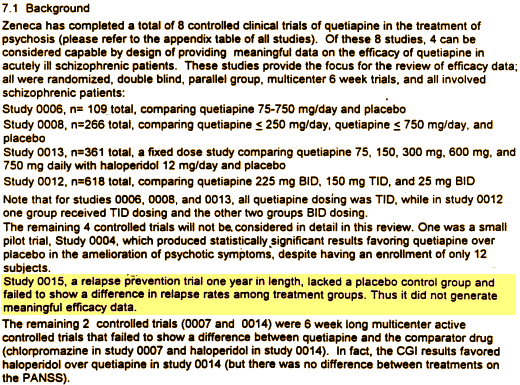
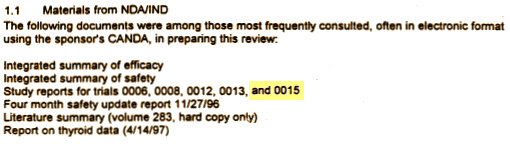
Trial 0015  was completed long before the F.D.A. approval application [1993-1995], so where was it? The answer is in another F.D.A. document- not the one we’ve been discussing, but one called Review and Evaluation of the Clinical Data. From that document:
 
And it’s not like the Trial 0015 hadn’t been looked over at the F.D.A.:
 
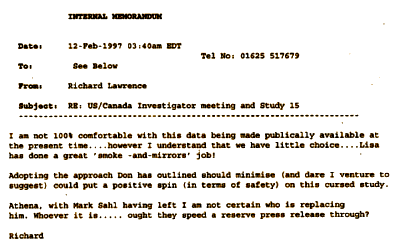
That write-up that says "… and failed to show a difference in relapse rates among treatment groups. Thus it did not generate meaningful efficacy data" bears no relationship to the truth about Trial 0015. As I’ve gone through the trials so far and we’ve looked at the graphs, I expect you’ve wondered something like, "But how does it compare to the Antipsychotics we already have?" I’m not used to looking at Clinical Trial data either, so I don’t know what they look like for the older drugs. Well they did but that’s not what got looked at at the F.D.A. Trial 0007 and Trial 0014 aren’t available, but are reported to show no difference between Seroquel and Thorazine or Haldol [or maybe they do]. But Trial 0015 is avaliable now for all to see. I’ll have a lot more to say about Trial 0015 later, but for now, here’s one of the internal documents about it:
And what was Lisa’s [Lisa Arvanitis] great ‘smoke-and-mirrors’ job? I think he’s referring to her writeup of the results:
    4.1.4 Summary of time to withdrawal / time to relapse There was no statistically significant dose response among SEROQUEL groups in the time to withdrawal from the trial in the intent to treat population, which was the primary efficacy variable. Pairwise comparison showed no statistically significant differences among any treatment group, including haloperidol, in the time to withdrawal from the trial. There was also no statistically significant dose.response among the SEROQUEL groups in the time to withdrawal from the trial for psychotic relapse. Times to psychotic relapse were generally longer in the haloperidol group. Pairwise comparisons of the time to withdrawal for psychotic relapse revealed statistically significant differences between the haloperidol group and each SEROQUEL group. However, there was an imbalance in the reasons for withdrawal from the trial between the SEROQUEL and haloperidol treatment groups with proportionally more patients in the haloperidol group withdrawing for adverse events. Since proportionally more censoring for relapse occurred in the haloperidol treatment group, any contrasts between the haloperidol and SEROQUEL groups for time to withdrawal for psychotic relapse may not reflect true differences in the relapse distributions among the groups and therefore are non.informative. Results of the analysis of the time to withdrawal in the secondary population showed a similar trend as seen in the intent to treat population. The analysis of prognostic variables indicated that only the interaction between treatment groups and the need for neuroleptic medication to be tapered during Segment A were significantly associated with time to withdrawal.
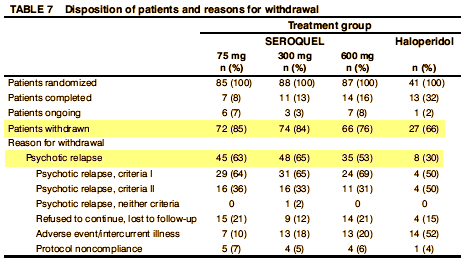
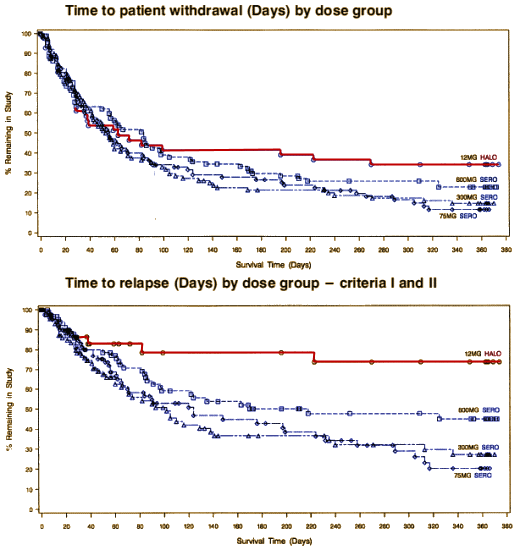
As to the study itself: 301 subjects were randomized into four groups treated with Seroquel 75mg/day, 300mg/day, or 600mg/day, and Haldol 12mg/day. The outcome measurements were how long they stayed on the medication? and how long before they relapsed?
Think that looks bad for Seroquel? Think it has no relevance to efficacy? Then try these:
Well, I think it’s relevant to efficacy. What it shows is that Seroquel is way less efficacious than Haldol [in spite of Haldol's side effects]. The phrase ‘smoke-and-mirrors’ doesn’t do her write up justice. It’s up there with Nixon’s "I’m not a crook" or Clinton’s "I didn’t inhale" and "I didn’t have sex with that woman." And Zeneca never published this study [on purpose as we will subsequently explore].
http://1boringoldman.com/index.php/2011/02/11/seroquel-v-through-the-looking-glass/

Seroquel IV: Ooching

Written By: 1 Boring Old Man

Posted on Thursday 10 February 2011

In another life long ago, I was an N.I.H. Fellow in "hard science" and as part of my Fellowship, they offered a chance to get a Master’s Degree in Statistics. I was young with lots of energy, so I took all the courses, but I never got it because you had to submit a paper, and I got whisked off to be a soldier, blah, blah, blah. The point was that I really liked it. We had some fine teachers. The group was all PhD.s in some kind of medical science and one Physician – me. We had a lot of fun, and since all of us were involved in research projects, we learned using "real" data. Once, our best professor said something like this. ‘In your careers, no matter what I say, you’re going to present your own data in the best light possible. That’s what people do. I can’t stop you. What I can say is don’t use statistics to try to make shit shine.’ At another time, he said, ‘Before you start prettying everything up, show your data in the rawest possible form. If you can see differences in the raw data, use your statistics to confirm your eyes. If you can’t see it in the data itself, even if your statistics find something, it’s usually trivial.’ So we brought in our raw data and he got us to guess what it would show before we headed for the computer [back in the days of "punch cards" and overnight main-frame runs] or the Frieden [rat-a-tat-tat] Calculators. I told you we had good teachers.
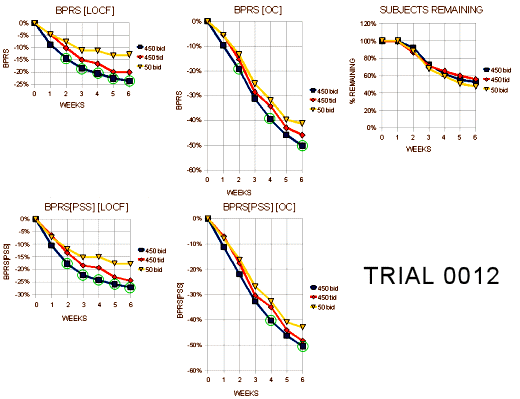
I thought about those days when I looked at this next study [Trial 0012].  Put the graphs on your screen, then roll your chair back six feet. You’ll see why. This was a European study that was both presented and published.
Seroquel (ICI204636): AnAtypical Antipsychotic- Results from Phase III
European Neuropsychopharmacology
Volume 6, Supplement 3 , Page 202, June 1996.
by DJ. King 1, C.G.G. Link
Department of Therapeutics & Pharmacology
The Queen’s University of Belfast, Northern Ireland
Zeneca Pharmaceuticals, Medical Research Department
Alderley Park, Macclesfield, Cheshire, England
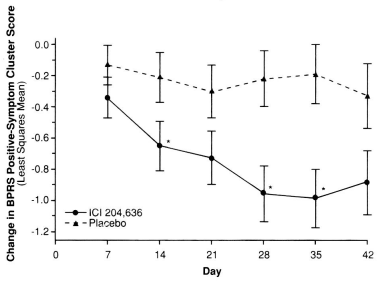
‘Seroquel’ (lCI 204636) is a dibenzothiazepine atypical antipsychotic agent. In phase 2 trials, ICI 204636 has been shown to be an effective antipsychotic with a low EPS potential. The SAFARI study was a 6 week, multicentre, randomised, parallel group comparison of ICI 204636, 225 mg bd, 150 mg tid and 25 mg bd in hospitalised patients with acute exacerbation of schizophrenia (DSM I1IR).The primary objectives of the study were to compare the clinical efficacy of 450 mg per day dosed bd vs tid with reference to a low dose of 50 mg per day on positive and negative symptoms (CG!, BPRS and SANS scores) and tolerability (AIMS and Simpson score for EPS). Results were analysed by ANCOVA with last observation carried forward. A total of 618 patients entered the randomised portion of the trial. On day 42, relative to the 25 mg bd group, 225 bd was shown to improve mean CGI score (p :’S 0.05) and reduce BPRS total score (p :’S 0.05) and SANS summary score (p=0.02). The 225 mg bd and 150 mg tid group were not distinguishable on BPRS, SANS or CG!. Twice daily dosing of ICI 204636 (450 mg/day) had a similar tolerability profile to tid dosing but an improved EPS profile as shown by the Simpson score when patients were dosed bd (p =0.04). No regimen was associated with increases in prolactin. It was concluded that, although ICI 204636 had a relatively short plasma elimination t½, there were therapeutic advantages from dosing twice as opposed to three times daily.
‘Seroquel’ is a trademark the property of Zeneca Limited.
Here are the F.D.A. Report’s comments and some of the data:
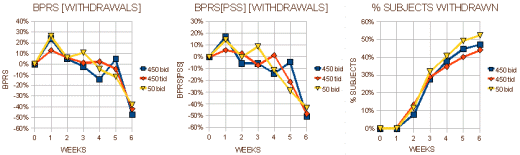
    "The intent of this trial was to show whether either dosing regimen of 450mg/day (tid vs bid) was better than the low dose (50mg/day), and whether the the higher dose regimens differed from each other. The trial was planned so that 170 patients/arm would provide 90% power to detect, a 6 point difference in change from baseline of the total BPRS between any two pairs of treatment arms. A total of 618 patients were randomized with 596 contributing at least one post-baseline observation on the BPRS… Approximately 50% of all patients completed the 6 week triaL. There was no relationship between dose and frequency of dropout due to lack of effcacy…"
I almost want to say that if you’re Schizophrenic, leave the U.S. I think their intention was for the 25mg bid [50mg.day] dose to be a homeopathic dose. But whether it was the very low dose or the non-American atmosphere, these patients improved a lot over the six weeks no matter what they were given to take. Here’s my graphic for the the "last observed" dose on the subjects who dropped out [a lot of late drop-outs here too]:
Say the reviewers:
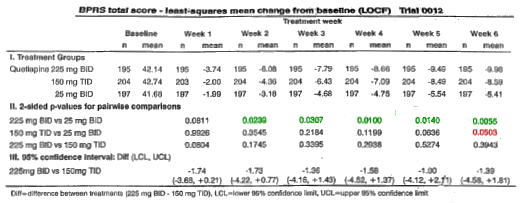
    "Tables 22a and 22b display the visit-wise results of the total BPRS for the LOCF and observed cases analyses, respectively. There was no plan for multiple comparisons in the protocol. However, the p=.005 for the bid dosage is sufficient for statistical significance. Also, the p=.05 for the tid dosage would be just significant using Fisher’s LSD. The confidence interval for the difference between the bid and tid dosages at 450mg rule out a 5-6 point average difference for the total BPRS. Tables 24a and 24b display the results of the key positive symptom BPRS cluster for the LOCF and observed cases, respectively. The bid regimen is significant for both the LOCF and observed cases analyses."
Up to this point, I was developing a friendly relationship with the F.D.A. reviewers. I understood what they were saying and agreed. But in this instance, I don’t get it after more re-readings than I’d like to admit. I think the problem they’re addressing is the one that bothers me. Here’s the table from the report that I find problematic. I’ve turned the significant values green. I think the reviewers are saying the one in red is too.
It’s not the trivial argument about a 0.003 fudge on significance that bothers me. It’s this:
  1. The 450mg dose [bid] is significantly different from the 50mg dose.
  2. The 450mg dose [bid] is not significantly different from the 450mg [tid] dose.
  3. The 450mg dose [tid] dose is [if anything] barely different from the 50mg dose.
Since number 2. says the two 450mg doses are the same, they should provide us with a comparison of the 50mg to the two 450mg doses lumped together as one group. If that doesn’t make sense, read it again. Instead of ooching up their confidence number, why didn’t they do the obvious thing? I can’t do it because I don’t have the actual numbers.
My professor never said this, but I left his courses thinking it whether he said it or not. If there’s an obvious statistical operation that would answer some question, and the author didn’t do it, you’ve got to wonder if they did it but just didn’t like the way it came out.
So, I don’t like the six foot from the screen test, or the curative powers of the European air, or the fact that they skipped an obvious statistical analysis. I guess I can live with confidence ooching [but I didn't like it either]. You’ll have to call this one for yourself. I’m underwhelmed. This evidence-based medicine business gets tricky at times.
http://1boringoldman.com/index.php/2011/02/10/seroquel-iv-ooching/

Seroquel III: Their Best Shot

 Written By: 1 Boring Old Man

 Posted on Thursday 10 February 2011

Moving along. Trial 0008 was Zeneca‘s most successful trial for Seroquel, published in a more widely distributed journal. I’ve included the abstract in part because it describes the actual dosing schedule for Seroquel omitted from the F.D.A. statistical report.
Quetiapine in patients with schizophrenia. A high- and low-dose double-blind comparison with placebo
Archives of General Psychiatry.
1997 Jun;54(6):549-57.
by Small JG, Hirsch SR, Arvanitis LA, Miller BG, Link CG.
Division of Mental Health, Larue D. Carter Memorial Hospital, Indianapolis, Ind.

Abstract
BACKGROUND: Quetiapine fumarate (Seroquel [ICI 204,636]) is an atypical dibenzothiazepine antipsychotic with a greater affinity for 5-hydroxytryptamine2 (5-HT2) receptors than for D2 dopamine receptors; its efficacy in patients with schizophrenia was shown in early phase 2 trials (maximum dose, 750 mg/d).
METHODS: In this multicenter, double-blind, placebo-controlled trial, 286 patients hospitalized with chronic or subchronic schizophrenia [DSM-III-R] were randomized to 6 weeks of treatment with high-dose quetiapine fumarate (< or = 750 mg/d), n = 96; low-dose quetiapine fumarate (< or = 250 mg/d), n = 94; or placebo, n = 96. The Brief Psychiatric Rating Scale (BPRS) and Clinical Global Impression Severity of Illness item scores were the primary efficacy variables. Secondary efficacy variables included the BPRS positive-symptom cluster score, the Modified Scale for the Assessment of Negative Symptoms summary score (United States only), and the total score from the negative scale of the Positive and Negative Syndrome Scale (Europe only). Scores were analyzed using an analysis of covariance for change from baseline at end point with last observations carried forward. The model included baseline score (covariate), center, and treatment. Extrapyramidal symptoms were assessed using the Simpson-Angus Scale and the Barnes Akathisia Scale; abnormal involuntary movements were assessed using the Abnormal Involuntary Movement Scale. Frequency distributions of grouped change-from-baseline scores were analyzed using chi 2 tests.
RESULTS: Of 280 patients in whom the efficacy of quetiapine was evaluated, 159 (42% of those receiving high-dose treatment; 57%, low-dose treatment; and 59%, placebo) withdrew before trial completion, primarily because of treatment failure. Significant (P < .001, BPRS; P = .003, Clinical Global Impression Severity of Illness item; and P = .003, BPRS positive-symptom cluster) differences were identified between patients receiving high-dose quetiapine and placebo for both primary efficacy variables, with end point differences in the BPRS positive-symptom cluster score showing quetiapine’s consistency in reducing positive symptoms. The reduction of negative symptoms was less consistent; high-dose quetiapine was superior on the Modified Scale for the Assessment of Negative Symptoms but not on the negative scale of the Positive and Negative Syndrome Scale. Quetiapine was well tolerated and did not induce extrapyramidal symptoms, sustained elevations of prolactin, or clinically significant changes in hematologic parameters.
CONCLUSIONS: Quetiapine is an effective antipsychotic with a favorable safety profile. The optimum dose is probably greater than 250 mg/d.
Here’s what the report said, followed by some of the data from Trial 0008:
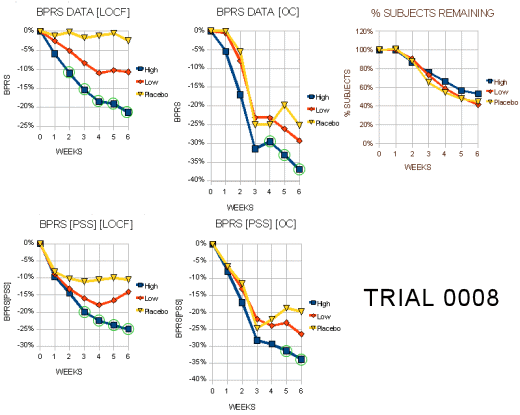
    "This 6-week study randomized a total of 286 patients among 37 centers in the US (59%) and Europe (41 %): N=96 High dose, N=94 Low dose, N=96 Placebo… A total of 4 patients had no post-baseline data, so that 282 patients comprise the effcacy ITT population. The endpoints of interest are BPRS total, key BPRS, CGI Severity and the negative PANSS (only in Europe) and the SANS (done only in the US). The protocol states that ANCOVA with baseline as the covariate would be used for all analyses. However, there is no plan for multiple comparisons among treatment arms. Table 1 displays the baseline conditions and demographics of the treatment groups. Completion rates were 50% for High dose, 43% for Low dose, and 41% for Placebo. ‘Treatment failure’ accounted for between 40%-50% of the dropouts."
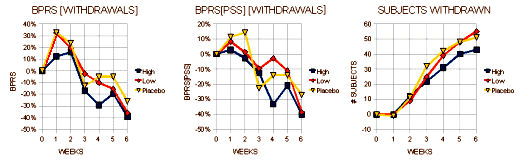
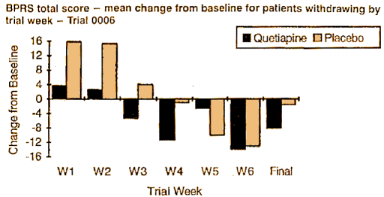
I expect the people at Zeneca were pretty pleased to see those LOCF graphs on the left. That’s exactly what they hoped for. Even the OC graphs have the green circles indicating statistical significance [though they're not quite so pretty]. Right now, we’re not talking about relevance so I’ll reserve any of those comments for a later time. Again, there were a lot of drop-outs. I’ve attempted to roughly translate the awkward bar graphs of the scores for the subjects that dropped out into a more readable form [the graph on the right is the inverse of the one above]:
As in Trial 0006, the early Trial 0008 patients who dropped out were getting worse – more in the Placebo and Low Dose ["< or = 250 mg/d"] groups, but it wasn’t enough to obfuscate the differences they were looking for [as always there are questions - why did so many who were decidedly better drop out at the end?]. Here’s what the reviewers said about Trial 0008:
    "Tables 3a and 3b display the visit-wise results of the total BPRS for the LOCF and observed cases analyses, respectively. It is not surprising that the high dose is statistically significant but the low dose is not, since the trial was planned (power= 90%) to find a 9 point difference between the high dose and placebo arms for the BPRS… Tables 5a and 5b display the results of the key positive symptom BPRS cluster for the LOCF and observed cases, respectively."
I wanted to look at the full text of the published article to see how they presented the data [and to see who was in the Acknowledgements - "medical writing"] but the download creeped along through an afternoon nap, some of the Egyptian revolution, and Mubarak’s interminable [and disappointing] speech. So I decided to let it run overnight during "off-hours." I’ll post that part later as an update.

For the moment I’ll say that this study does seem to show Seroquel to be an antipsychotic drug – nothing to set off fireworks or to write home about, but an antipsychotic drug nonetheless. As for the Clinical Trials world itself, it’s not a direct learning lab for the practice of clinical medicine. In this study, it took three or four weeks to separate itself from placebos. But the two findings that actually impressed me in this and the last study were:
  1. In the first few weeks, Seroquel appeared to allow the subjects to stay in the study, suggesting that it was helpful early on.
  2. The High Dose Seroquel group had a 9% lower drop-out rate overall, again suggesting it was helpful.
The idea of "keeping people on the medication" as an index of success will play an increasingly prominent role in later studies of efficacy, but for the moment, Zeneca put a point on their side of the scoreboard for Seroquel approval with Trial 0008.

Update [at 1:00 AM it downloaded immediately]:
Well, to the Acknowledgements:
    Accepted for publication November 6, 1996. This study was supported by a grant from Zeneca Pharmaceuticals, Macclesfield, England, and Wilmington, Del. We thank Suzanne Bristow-Marcalus for medical writing support; Jean Fennimore, RN, and Alison Smith, MSc, for trial organization and management support; Gary Cooper, MS, Jacqueline Fiore, Lesley Farrow, and Barney Home for trial monitoring support; and Kathleen Jelliffe, Denise Redkar-Brown, Joy Russo, and Thais Womack for data management support.
By today’s standards, that’s suspect for ghost-writing. I think we can safely assume that this article was written in Delaware at Zeneca‘s headquarters. 
http://1boringoldman.com/index.php/2011/02/10/seroquel-iii-their-best-shot%E2%80%A6/

Seroquel II

Written By: 1 Boring Old Man

Posted on Wednesday 9 February 2011

Well, my first seroquel II was premature so I pulled it. Like AstraZeneca itself, I rushed to market before I knew exactly how I wanted to go through the FDA Approval document. This is Version 2.0. What’s new in Version 2.0, you ask? First off, there are a couple of buttons scattered around that pop-up either the FDA 1997 Report on Seroquel itself or my rewrite with essential text and data shown graphically [rather than in imponderable tables]. It’s just kind of useful to have the data at hand so I can talk about it without having to show it over and over. The other difference is that I’m looking at the studies oldest first instead of ‘best’ first.
The Report I’m looking over is the one prepared for the F.D.A. Approval Panel for Seroquel in February 1997.  Zeneca Pharmaceuticals submitted four studies for consideration. The oldest study was Trial 0006, a multicenter six week double blind placebo controlled trial. This study had  already been published:
    ICI 204,636, an Atypical Antipsychotic: Efficacy and Safety in a Multicenter, Placebo-Controlled Trial in Patients With Schizophrenia by Borison, Richard L. MD, PhD; Arvanitis, Lisa A. MD; Milier, Barbara G. MS. Journal of Clinical Psychopharmacology 1996 Apr;16(2):158-69. abstract
At the time, Dr. Borison was Chairman of the Department of Psychiatry at the Medical College of Georgia and Dr. Arvanitis and Ms. Miller were on the staff of Zeneca. This article was accepted in January 1995 and published in April 1996. Two months after this article was published, Dr. Borison abruptly resigned when it was revealed that he was involved in a massive scam conducting Clinical Trials under the name of the Medical School, but pocketing the money himself [~$10 M]. About the time the F.D.A. was evaluating Seroquel, Borison was being indicted with 172 counts of fraud. He was later convicted and sentenced to 15 years in prison. So I guess this article was his swan-song. In addition, if you have access to the full text, the acknowledgements read like those of "ghost-written" articles [1997 was during the heyday of such shenanigans].

The F.D.A. report describes the trial this way:
    "This Phase II trial consisted of one flexible dosing arm of Seroquel (75 mg/day – 750 mg/day) and a placebo arm. The protocol called for 50 patients per arm in order to have 90% power to detect an 8 point difference in change from baseline BPRS between the Seroquel arm and placebo. A total of 109 patients were randomized (Seroquel N=54, Placebo N=55) among 11 centers in the US. However, 3 patients had no post-baseline data leaving 53/group available for analysis. For the 106 patients analyzed, the completion rates were 53% for Seroquel and 42% for placebo."
In the published version, they were more explicit about the dosage:
    "Patients randomized to treatment with ICI 204,636 initially received 25 mg three times a day for 1 to 2 days. Thereafter, the dose was titrated upward, using a combination of 25-, 50-, 100-, and 200-mg tablets, until an adequate therapeutic effect was achieved… The maximum daily dose was 750 mg, but daily doses greater than 500 mg were limited to 14 days… Patients randomized to placebo treatment received matching placebo tablets in the same manner as patients treated with ICI 204,636."
I have an agenda in looking at this document. First, I’m really curious how Seroquel got to be such a blockbuster drug approved for so many things, and this seems to be the place to start. Second, I read a lot of those subpoenaed documents about the deception going on behind the scenes, so I wanted to connect it with the main stage. Finally, I wanted to see how the Clinical Trial scene works, its having occupied such a major role in my profession for the last quarter century of evidence-based medicine. That said, here’s some of the data from Trial 0006.
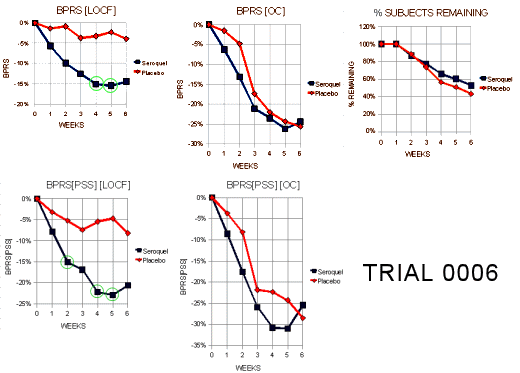
They recorded various outcome rating scales at weekly intervals throughout the study. I graphed the results from the two main scales, the Brief Psychiatric Rating Scale {BPRS} and its Positive Symptom Subscale {BPRS[PSS]} – the scale most likely to show changes in psychotic symptoms – as the % fall from the baseline [that's how such things are usually reported].
We only have the data for the group means in this report, not the raw values, so we can’t directly see the "scatter." We have to rely on the statistical analysis to tell us if differences are meaningful. The significant measurements are circled with green [p<0.05]. Then there are two abbreviations – LOCF [Last Observation Carried Forward] and OC [Observed Cases]. Subjects in Clinical Trials are free agents and they can quit any time they want to. They can quit for reasons that have nothing to do with the study, or because of side effects, or because the treatment doesn’t work, or any of the infinite reasons that motivate mankind – but the point is they do quit with regularity and the investigators have to figure out what to do in their absence. In this study, 42%/53% [Placebo/Seroquel] didn’t complete the whole 6 weeks. A standard method is LOCF – meaning that you use the last observed value for the remainder of the study for the departed subjects. It’s an annoyingly inelegant solution, but it’s hard to figure out another option [If you want to explore the topic, this is a decent discussion]. Fortunately, unlike the statistics, we at least get to see that raw data in the OC graph which only shows the values for the Observed Cases.
On the topic of LOCF, look at the top center graph. It looks like Schizophrenic patients get better on sugar pills. That’s hardly likely.  Schizophrenia is bigger than just "placebo effect." What I’d guess it probably means is that the Schizophrenic subjects that were getting better are the ones that stuck with the study to the end. It’s true for the BPRS[PSS] data as well. In fact, if you click the button that says "GRAPHIC," you can scan down all four studies in this report and see that it’s true for all of them – both the placebo and the treated groups get "more better" over time in the OC graphs compared to the LOCF graphs. I suppose we can guess that people who are in the study and feeling improvement stay with the program [this is the kind of thing that results is premature balding in Investigators]. Notice also that the only significance is in a few of the weekly measurements, but not at the end of the study. Likewise, the significance is only in the LOCF graph. This is not a particularly interpretable study [in spite of what Borison and Arvanitis said in their published paper]. This alone wouldn’t get you through the F.D.A. [I hope]. Here’s what the reviewers said:
    "Tables l0a and l0b display the visit-wise results of the total BPRS for the LOCF and observed cases analyses, respectively. The borderline statistical result for the LOCF is likely due to the less than anticipated treatment difference at 6 weeks (-8.1 vs -2.1). Note that there was no difference at all for the completers. Thus, Figure 5 indicates that the entire treatment difference in the LOCF analysis is due to dropouts in the first 4 weeks of the trial."
The reviewers had the raw numbers. They compiled the "last observations" that were "carried forward." What they could see was that those early drop-outs in the placebo groups who were getting worse added a skew to the graphs that pushed it into the realm of guessing instead of science. That’s not Zeneca‘s fault. That’s the real world. In ancient times when all of these patients would have been housed in a State Mental Hospital, they could’ve gotten data on 100% of the participants. It would’ve been like the animal room in the Psychology Professor’s laboratory. Then there would only be one graph – Observed Cases – with no "corrections" required. In that case, the heterogeneity of the Schizophrenic patients that probably explains their results and throws us into the guessing game would have been amenable to scientific analysis. Such things are usually managed by having large subject cohorts in lots of different sites [which costs a bundle]. They project [guess at] such things mathematically:
    "Power calculations were based on the ability to detect a minimum difference of 8 units between mean changes from baseline in BPRS total scores. A variance estimator from a previous study (mean square error of 123.9; data on file, ZENECA Pharmaceuticals) was used to determine that 50 patients per treatment group would allow detection of this difference with a power of at least 0.90 and a two-sided alpha = 0.05 level test."
It looks as though they missed this time. Trial 0006 would not get the job done with a reviewer who had all the facts [the raw data]. The "drop-out" variable and the heterogenity of their Schizophrenic subjects carried the day. But all the information wasn’t available to someone reading the paper that Drs. Borison and Arvanitis published. Embedded in the text they mention the drop-outs:
    Twenty-six patients treated with ICI 204,636 and 33 placebo-treated patients withdrew before completing 6 weeks of treatment for reasons shown in Table 1. The majority of withdrawals [16 in the ICI 204,636 group; 27 in the placebo group] were attributed to treatment failure.
But they don’t show the impact of the drop-outs on the data. They simply show us their version of the LOCF graph:
And they conclude:
    In this placebo-controlled, multicenter trial, ICI 204,636 was effective in the treatment of the positive and negative symptoms of schizophrenia. Significant differences (p less or equal to 0.05) between treatment groups were identified for the primary efficacy variables, the BPRS total score and CGI Severity of Illness item score, at most times throughout the trial, with marginal significance achieved at endpoint (p = 0.07 for both)…
Maybe. Maybe not. With Trial 0006, we can’t say either way that Seroquel is what what Zeneca wants it to be. And from their published results, we wouldn’t know that it’s a guessing game at this point. But as long as they’ve thrown us into the world of guessing, I’m going to make a guess too. My guess is that the published study paid for by Zeneca and co-authored by two Zeneca employees and America’s legendary Academic-Psychiatrist-for-hire, Dr. Borison [at the height of his Madoff-like career], was ghostwritten:
    This trial was supported by a grant from ZENECA Pharmaceuticals, Wilmington, DE. SEROQUEL is a trademark, the property of ZENECA Limited. We thank Suzanne Bristow-Marcalus, RPh, ELS, for medical writing support; Jean Fennimore for trial organization and management support; Jacqueline Fiore and Gary Cooper for trial monitoring support; and Kathleen Jelliffe, Denise Redkar-Brown, Joy Russo, and Thais Womack for data management support.
But I can’t prove that anymore than Trial 0006 proves Seroquel’s efficacy. Three+ studies to go…

http://1boringoldman.com/index.php/2011/02/09/seroquel-ii-version-20-guessing/

Seroquel 1: Introduction

 Written By: 1 Boring Old Man

Posted on Tuesday 8 February 2011

As a practitioner I never used to pay a lot of attention to Clinical Trial data. I assumed that if the FDA approved a drug, it meant that it was effective and that it added something to the drug armamentarium we already had. Back in the days when I was actively involved with treating psychotic patients [Schizophrenia], we had a collection of anti-psychotic drugs [now called the First Generation Antipsychotics] that all worked, but had somewhat different side effect profiles. I used the ones that had the least side effects [but they all had them]. I guess the rule was to find the lowest dose of the one the patient was most likely to take. They’re hard drugs to use. There’s a constant worry about side effects [particularly the irreversible one - Tardive Dyskinesia] and the effect of "drugging" the patient’s mind. On the other side of that coin is a crippling psychosis that once sentenced patients to an "Institutionalized" Life. It’s very easy to get stuck on the evils of one or the other side of that problem – to argue about being able to live freely in society, or to see drugs as a toxic chemical straight-jacket. For some, one doesn’t have to struggle and things go smoothly. But for a significant number of people with that illness, there’s no "right course" and one has to live in that netherworld as a Psychiatrist, just as the afflicted live there themselves. I’d been there before with the sometimes toxic treatments used in severe physical diseases [those dire warnings they mumble at the end of the t.v. drug commercials], but somehow the conflict feels different in Psychiatry, but that’s another very long subject for another day.
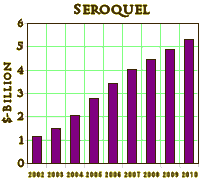
Right now, I want to focus on the Atypical Antipsychotic drug Seroquel, one that’s often in the news, and in the stories about the intrusion of the Pharmaceutical Industry into the practice of Medicine [Psychiatry] over the last twenty or thirty years. The Atypical Antipsychotics are a group of drugs that are chemically different from the older drugs. When they began to appear, they were touted as having less extrapyramidal side effects [so less chance of irreversible Tardive Dyskinesia] and a diminished side effect profile in general. I had little to no experience with the drugs in my practice as a psychoanalytic psychotherapist, but in retirement I volunteer in clinics where I see some psychotic patients and a whole lot of people who have been started on these drugs elsewhere. The thing of it is, most of the people I see on Seroquel aren’t psychotic – nor have they ever been. Since its FDA approval, it was later approved for Mania [another psychotic illness] and then even later as an add-on medication for people with Major Depressive Disorder [psychotic or not] that don’t respond to anti-depressants [SSRIs]. In practice, it seems to be being used for depressed people even if they don’t have "Major" depression, or people who have Anxiety, or people who have any number of other things including PTSD or insomnia of any kind. It’s being used a bit like the Benzodiazepines as an all purpose anxiolytic/sedative drug [we don't use the Benzodiazepines much anymore except short-term because they tend to be habituating and addictive]. The staggering point is that the Atypical Antipsychotics are the number one drugs prescribed in the U.S. right now [by cost]. And Seroquel is the number one in the class – to the tune of $4.9 Billion last year [2009]! Cough.
If you’re reading this, you can’t have missed that AstraZeneca and its Seroquel have been on the radar of the increasing throng of people up in arms about Pharmaceutical Companies using Physicians in stealth advertising of their drugs, particularly in Psychiatry – paid Speaker’s Bureaus, Ghost-writing, Scientific Advisory Boards, Continuing Medical Education, unacknowledged Conflicts of Interest, direct relationships with Key Opinion Leaders and Academic Psychiatrists. In 2008, Senator Chuck Grassley’s investigations and the numerous suits against Pharmaceutical Companies belatedly put some of these practices on the front pages of our newspapers. I’ve been writing about these things a lot myself, including some things about Seroquel.
Recently, Stephany [soulful sepulcher] sent me the URL of a key to a sea of documents released in May 2009 from one of the cases against AstraZeneca [a suit about covering up the incidence of weight gain and Diabetes as a side effect]. I’d seen the document archive before, but was overwhelmed by the volume]. I’d failed to see the key that allows finding the various threads among the array of files [I really appreciate her sending it]. I’ve spent a few days perusing the memos and emails. It’s pretty incriminating stuff – people talking about how to hide or minimize negative studies, how to avoid mentioning side effects, having affairs with each other, how to hype off label uses, how to spin all sorts of things – incriminating and sometimes disgusting. As I’ve read through the evidence, I keep wondering how all this seedy business played out in getting the drug through the F.D.A. and on the market [and into such widespread and lucrative use].
What I’ve learned from the patients is that it’s a lightweight antipsychotic at best. The weight gain seems almost universal, and often prohibitive. When I ask people who are on it what it does for them, they sometimes say, "it calms me down," more usually say "It puts me to sleep," or even say "I can’t sleep without it." Depressed people on anti-depressants who have gotten it as an add-on say the same things. As a clinician, I’m underwhelmed. So instead of looking at those internal AstraZeneca documents or the suits against the company, I’ve decided I want to go back and look at the beginning – how it got approved. I’m not the first person to walk this road, but I want to do it myself as a way of getting into this Clinical Trial world I talked about in that evidence-based medicine series I meandered through recently. It’s a long, cold, winter here in the Georgia mountains, and this is as good a hobby as any until the place thaws out and I can get back to communing with whatever old people commune with when they move to the woods. So the question, "How did Seroquel, a softy with a big downside, get approved in the first place? for so many things? and get to be such a financial blockbuster?" Maybe after looking at those Clinical Trials that got Seroquel approved, I’ll reference some of those juicy, unsavory documents in that document archive…
http://1boringoldman.com/index.php/2011/02/08/seroquel-i-introduction-of-an-atypical/

Top 10 Pharma CEO Salaries of 2010

By Liz Hollis and Erica Teichert
Welcome to our annual look at the biggest CEO in the pharma industry. Despite a year fraught with manufacturing issues and drug recalls, Johnson & Johnson CEO Bill Weldon takes the top spot, with $28.7 million in 2010 pay. And Novartis' Daniel Vasella grabs the number two spot thanks to a lucrative golden handshake.
Next year we'll have to say goodbye to a few familiar faces that are making their final appearance on this list. Pfizer's Jeff Kindler won't be back next year, nor will Vasella or Richard Clark of Merck. All of these CEOs will be replaced by new executives that will appear on the list. For example, Ian Read, Pfizer's new CEO, earned more than $17 million last year, even though he didn't become CEO until Dec. 5. George Scangos, formerly of Exelixis and now Biogen Idec CEO, was paid $9.4 million last year--and he didn't come on board until more than halfway through the year.
Others are waiting, too. Allergan's David Pyott ($12.7 million), Bristol-Myers Squibb's Lamberto Andreotti ($11.8 million) and Baxter's Robert Parkinson ($11.5 million) were close to making the list. Click below to get all the details on the top 10 highest paid biotech and pharma CEOs of 2010.
1. Bill Weldon - J&J - $28.7M
2. Daniel Vasella - Novartis - $27M
3. Miles White - Abbott-  $25.6M
4. Jeffrey Kindler - Pfizer-  $24.7M
5. Richard Clark - Merck - $24.6M
6. Robert Coury - Mylan - $22.9M
7. Kevin Sharer - Amgen - $21.1M
8. James Mullen - Biogen Idec - $20M
9. John Lechleiter - Eli Lilly - $16.5M
10. John Martin - Gilead Sciences - $14.2M

Read more: Top 10 Pharma CEO salaries of 2010 - FiercePharma http://www.fiercepharma.com/special-reports/top-10-pharma-ceo-salaries-2010#ixzz1SeJoydLM
Subscribe: http://www.fiercepharma.com/signup?sourceform=Viral-Tynt-FiercePharma-FiercePharma

Exercise and Depression

(This article was first printed in the Special Health Report from Harvard Medical School "Understanding Depression". For more information or to order, please go to www.health.harvard.edu/UD.)


Can a few laps around the block actually solve your emotional problems? Probably not, but a regular exercise program might help. A review of studies stretching back to 1981 concluded that regular exercise can improve mood in people with mild to moderate depression. It also may play a supporting role in treating severe depression.
Another study, published in the Archives of Internal Medicine in 1999, divided 156 men and women with depression into three groups. One group took part in an aerobic exercise program, another took the SSRI sertraline (Zoloft), and a third did both. At the 16-week mark, depression had eased in all three groups. About 60%–70% of the people in all three groups could no longer be classed as having major depression. In fact, group scores on two rating scales of depression were essentially the same. This suggests that for those who need or wish to avoid drugs, exercise might be an acceptable substitute for antidepressants. Keep in mind, though, that the swiftest response occurred in the group taking antidepressants, and that it can be difficult to stay motivated to exercise when you’re depressed.
A follow-up to that study found that exercise’s effects lasted longer than those of antidepressants. Researchers checked in with 133 of the original patients six months after the first study ended. They found that the people who exercised regularly after completing the study, regardless of which treatment they were on originally, were less likely to relapse into depression.
A study published in 2005 found that walking fast for about 35 minutes a day five times a week or 60 minutes a day three times a week had a significant influence on mild to moderate depression symptoms. Walking fast for only 15 minutes a day five times a week or doing stretching exercises three times a week did not help as much. (These exercise lengths were calculated for someone who weighs about 150 pounds. If you weigh more, longer exercise times apply, while the opposite is true if you weigh less than 150 pounds.)
How does exercise relieve depression? For many years, experts have known that exercise enhances the action of endorphins, chemicals that circulate throughout the body. Endorphins improve natural immunity and reduce the perception of pain. They may also serve to improve mood. Another theory is that exercise stimulates the neurotransmitter norepinephrine, which may directly improve mood.
Besides lifting your mood, regular exercise offers other health benefits, such as lowering blood pressure, protecting against heart disease and cancer, and boosting self-esteem. How often or intensely you need to exercise to alleviate depression is not clear, but for general health, experts advise getting half an hour to an hour of moderate exercise, such as brisk walking, on all or most days of the week.

(This article was first printed in the Special Health Report from Harvard Medical School "Understanding Depression". For more information or to order, please go to www.health.harvard.edu/UD.)

Tuesday, July 19, 2011

Suicide Survivor Resources

Suicide Survivor Resources

Find a Suicide Prevention Support Group Near You
American Association for Suicidology Survivor Fact sheet
What you can do to help a survivor of suicide, from the American Association for Suicidology
Download a copy of the American Foundation for Suicide Prevention's Resource and Healing Guide
The American Association for Suicidology Web site provides a wealth of resources for survivors, including stories from other survivors, books for survivors and information on how to facilitate a support group.
The American Foundation for Suicide Prevention provides information for survivors, including ways to cope with your loss.

Suicide Prevention Coalition of Colorado

About Us

About SPCC The Suicide Prevention Coalition of Colorado was formed in 1999, when a group of concerned citizens set out to create a statewide agency with the purpose of preventing suicide and creating a resource network for those who were working to prevent suicide around the state.

Today, SPCC’s membership of concerned agencies, organizations and individuals who are working in the areas of suicide prevention,
                                          intervention and postvention has statewide reach.

As a Coalition, we:

  • Can achieve more widespread reach within Colorado than any single organization could attain
  • Can speak in a larger & more powerful voice than any individual organization
  • Can provide a range of advice and perspectives to the Office of Suicide Prevention, the media, legislators or the general public
  • Can foster cooperation and collaboration between grassroots organizations, community members and/or diverse sectors of a large organization
     
Read about the history of SPCC

We are work to ensure that everyone in Colorado has access to the best resources, educational opportunities and advocacy efforts.

Our statewide directory of resources, a project completed in partnership with the Colorado Office of Suicide Prevention, is available to anyone who is seeking information on suicide prevention, mental health and other issues. Click here to download the statewide directory of resources.

MISSION: The mission of the SPCC is to reduce suicide and its impact for all Coloradans through advocacy, collaboration and education.


Become an SPCC Member

When you click this button, a new window will open. You will be directed to a page for Blacktie-Colorado. Blacktie is a secure website with shopping cart capabilities for non-profits in Colorado.  RMRPI (the Non-Profit Beneficiary whose name appears on the Blacktie page) is SPCC's fiscal sponsor and handles our membership finances.  Please include a note that specifies "SPCC Membership" or "SPCC Donation" in the Comments section of the form.

Sunday, July 17, 2011

Seroquel

What is Seroquel?

Seroquel (quetiapine) is an antipsychotic medication. It works by changing the actions of chemicals in the brain.
Seroquel is used to treat schizophrenia in adults and children who are at least 13 years old. It is used to treat bipolar disorder (manic depression) in adults and children who are at least 10 years old.
Seroquel is also used together with antidepressant medications to treat major depressive disorder in adults.
Extended-release quetiapine (Seroquel XR) is for use only in adults and should not be given to anyone younger than 18 years old.
Seroquel may also be used for other purposes not listed in this medication guide.

Important information about Seroquel

Do not take more Seroquel than your doctor has prescribed. An overdose of quetiapine can be fatal.
Seroquel is not for use in psychotic conditions related to dementia. Seroquel may cause heart failure, sudden death, or pneumonia in older adults with dementia-related conditions. Stop using Seroquel and call your doctor at once if you have the following symptoms: very stiff (rigid) muscles, high fever, sweating, confusion, fast or uneven heartbeats, tremors, uncontrolled muscle movements, feeling light-headed, blurred vision, eye pain, increased thirst and urination, excessive hunger, fruity breath odor, weakness, nausea and vomiting.
You may have thoughts about suicide when you first start taking an antidepressant, especially if you are younger than 24 years old. Your doctor will need to check you at regular visits for at least the first 12 weeks of treatment.
Report any new or worsening symptoms to your doctor, such as: mood or behavior changes, anxiety, panic attacks, trouble sleeping, or if you feel impulsive, irritable, agitated, hostile, aggressive, restless, hyperactive (mentally or physically), more depressed, or have thoughts about suicide or hurting yourself.

Before taking Seroquel

Seroquel is not for use in psychotic conditions related to dementia. Seroquel may cause heart failure, sudden death, or pneumonia in older adults with dementia-related conditions.
To make sure you can safely take Seroquel, tell your doctor if you have any of these other conditions:
  • liver or kidney disease;
  • heart disease, high blood pressure, heart rhythm problems;
  • a history of heart attack or stroke;
  • a history of low white blood cell (WBC) counts;
  • a thyroid disorder;
  • seizures or epilepsy;
  • cataracts;
  • high cholesterol or triglycerides;
  • a personal or family history of diabetes; or
  • trouble swallowing.
You may have thoughts about suicide when you first start taking an antidepressant such as Seroquel, especially if you are younger than 24 years old. Tell your doctor if you have worsening symptoms of depression or suicidal thoughts during the first several weeks of treatment, or whenever your dose is changed.
Your family or other caregivers should also be alert to changes in your mood or symptoms. Your doctor will need to check you at regular visits for at least the first 12 weeks of treatment.
FDA pregnancy category C. Tell your doctor if you are pregnant or plan to become pregnant while using this medication. Taking antipsychotic medication during the last 3 months of pregnancy may cause problems in the newborn, such as withdrawal symptoms, breathing problems, feeding problems, fussiness, tremors, and limp or stiff muscles. However, you may have withdrawal symptoms or other problems if you stop taking your medicine during pregnancy. If you become pregnant while taking Seroquel, do not stop taking it without your doctor's advice. It is not known whether quetiapine passes into breast milk or if it could harm a nursing baby. You should not breast-feed while you are taking this medication. Do not give Seroquel to a child without a doctor's advice. Extended-release quetiapine (Seroquel XR) is for use only in adults and should not be given to anyone younger than 18 years old.

http://www.drugs.com/seroquel.html

Pharmaceutical fraud: How Big Pharma's marketing and profits come before consumer safety and wellness. By Dani Veracity


If you have a long, drawn-out, incurable but treatable disease, it's unfortunate for you but great for pharmaceutical companies. While you're suffering indefinitely, you're also buying expensive pharmaceutical drugs to make the disease "manageable." "Managing" diseases is the trend in mainstream medicine, and it's the main message that pharmaceutical companies and the media market to consumers. "You have a mental disorder? That's okay. You can live a normal life, if you take these pills every day."
According to "AIDS: A Second Opinion" authors Gary Null and James Feast, the profits "stack up better" for pharmaceutical companies when people have to take treatments indefinitely for an incurable disease. HIV, for example, is a relative goldmine, since HIV-positive people have to take drug "cocktails" each day even before they develop symptomatic AIDS. Then, the profits add up even more after these people develop full-blown AIDS because they have to take drugs to treat opportunistic infections in addition to their regular drug cocktail.
Many people believe that pharmaceutical companies' hunger for profits triumphs over their desire to genuinely help the public, and that this blinded concern for profit above all has shaped -- and continues to shape -- mainstream medicine as we know it. The bottom line is simple: As Life Extension Magazine puts it, "Marketing issues frequently outweigh medical science in drug company decisions."

Modern medicine is a platform for profit, not health

This has implications that are more serious than one might initially think, especially considering the heavy role that pharmaceutical companies play in mainstream medicine. "Deep Healing" author Dr. Emmette Miller writes, "We have to remember that most medical research in this country is financed by pharmaceutical companies who are looking for new drugs they can produce and sell." Now, things were not always this way. In his book, "Overdosed America," Dr. John Abramson describes the shift of medical research from the academic to the commercial sphere: "As the function of medical research in our society has been transformed from a fundamentally academic and scientific activity to a fundamentally commercial activity, the context in which the research is done has similarly changed: First in universities funded primarily by public sources, then in universities funded primarily by commercial sources, then by independent for-profit research organizations contracting directly with drug companies. And most recently, the three largest advertising agencies, Omnicom, Interpublic and WPP, have bought or invested in the for-profit companies that perform clinical trials." In my view, advertising agencies having financial ties to the companies that perform clinical trials – companies that are supposed to conduct objective research – is blatant conflict of interest; yet it's the basis of most mainstream medical research in the United States. In fact, according to Dr. Abramson, in the year 2000, only one-third of all medical research was performed in universities and academic medical centers.
Since, according to these and other sources, drug companies predominantly fund medical research, scientists have almost no choice but to mainly focus their time and effort on the most profitable, but not necessarily the most effective, treatments. Though an herb, which by its very nature cannot be patented, may treat and possibly even cure a disease, drug companies may nevertheless not fund research or marketing for it, leaving the general public largely ignorant of the herb's benefits. Mainstream medicine largely dismisses vitamins and minerals in the same manner as herbs.
Furthermore, research bias often continues into the doctor's office. As Gary Null writes in his Complete Guide to Health and Nutrition, "One report published in Fact magazine speculates that the principle reason vitamin C is not commonly prescribed is that it is not as profitable as those syrups and pills your doctor dispenses."

Stealing medicine from nature

However, this doesn't mean that pharmaceutical companies ignore plants and other natural medicines altogether; it's actually quite the opposite. According to Asian Health Secrets by Letha Hadady, approximately one-third of all pharmaceuticals are derived from plants' active ingredients. Though companies cannot patent natural plants in their whole form, they can patent plants' individual ingredients after a long, painstaking process of breaking down the plant into its components, isolating active ingredients and then claiming to have "discovered" these natural ingredients. However, this system, though profitable for drug companies, has a downside that Hadady reveals: "Many times the active ingredient does not work as well as the entire plant. According to tests done in Germany, Saint John's Wort, the entire herb, kills the AIDS virus in the test tube, while hypericum, the isolated active ingredient, does not." In other words, though the bottom line is simple, it means that this society is in a very dangerous predicament indeed. This horrific state of modern medicine is a uniquely American phenomenon, according to "Innocent Casualties" author Elaine Feuer. She writes, "Because the U.S. is the only major industrialized nation that does not regulate the prices or profits of drug companies, prescription drugs generally cost 25 to 40 percent more than in other countries." In fact, drug companies rely on American sales for the bulk of their profits, even though many of their products are marketed worldwide, says "Natural Alternatives to Drugs" author Dr. Michael T. Murray.
Though this is bad for the average American consumer, it's great for pharmaceutical companies. According to Mike Fillon's book, "Ephedra Fact and Fiction," the global pharmaceutical market earned $364 billion in 2001, making it the world's most profitable stock market sector. Fillon writes that more than half of this revenue is from the United States alone, so although pharmaceuticals are more expensive for the American consumer, Americans still buy more prescription drugs than any other nation.

Hawking for Big Pharma

Now, at this point, you're probably wondering about the role the U.S. government plays in all this. In "Death by Prescription," Ray D. Strand writes, "The FDA is actually listening and catering to the industry's desires." According to Strand, the FDA facilitates the drug-approval process. Many people attribute the FDA's bias against herbs and other natural medicine to the agency's close "friendship" with the pharmaceutical industry, but it seems that they can't agree about the level of corruption. According to American Medical Publishing's book, "Prescription Medicines, Side Effects and Natural Alternatives," "The government is also part of the problem because it does not have the resources or the political will to do more about the dangers of prescription drugs. Also, powerful members of the American government, from the President on down, are all lobbied heavily by the cash rich drug companies." In order for mainstream medicine to reach the level of effectiveness that it can and should attain, the inner workings of the medical community must change, starting with the pharmaceutical companies' hold on the government agencies that are supposed to protect American consumers. As Burton Goldberg writes in "Alternative Medicine," "To realize effective health care with cost reduction requires unlocking the strangulation hold of the pharmaceutical companies, the American Medical Association (AMA) and ... the FDA on all forms of fully effective, low-cost alternative, complementary, integrative, holistic medicine." Until then, mainstream medicine will remain the same, and that's the last thing American consumers need. It's time to put concern for public health, medicine and genuine science over corporate profits.
The experts speak on pharmaceutical companies and profits:
There is probably nothing more profitable to the drug companies than interminable treatment of patients with drugs that do not work. Yet countless patients, at great cost to our nation, are kept on these treatments because they have been proven to help two-thirds of people and health-care providers have no policies or procedures to do otherwise. When those who pay the bills realize how much of their money is being wasted, and how much can be saved by requiring policies and procedures to identify patients not helped by standard treatment and select alternatives for them, it may happen.
Alternative Medicine by Burton Goldberg, page 458
Diabetes is such a profitable business that physicians will put pre-diabetic patients, with only marginally high blood sugar, onto diabetes drugs before even trying weight loss and exercise.
Prescription Alternatives by Earl Mindell RPh PhD and Virginia Hopkins MA, page 403
With the growing epidemic of obesity, the drug companies can look forward to a financial windfall. Many millions of Americans will be taking their statin drugs to lower their cholesterol levels. And they could each be spending $3 a day, or $1100 a year, for the rest of their lives.
Health Care Meltdown by Robert H Lebow MD, page 229
Drug companies are profit-driven entities, so marketing issues weigh very heavily. Manufacturers feel great pressure to keep costs down while hastening new drugs to market. And drug companies aren't held responsible for the huge costs of dose-related side effects to the healthcare system. The result is that marketing issues frequently outweigh medical science in drug company decisions.
Disease Prevention And Treatment by Life Extension Foundation, page 723
We have to remember that most medical research in this country is financed by pharmaceutical companies who are looking for new drugs they can produce and sell. Psychoneuroimmunology research is aimed at showing that the body is capable of producing its own healing substances. The bottom line is that stockholders of the companies that invest in medical research can't see how they can profit from such research and so will naturally put their developmental money into the money-making ventures instead.
Deep Healing by Emmette Miller MD, page 138
As the function of medical research in our society has been transformed from a fundamentally academic and scientific activity to a fundamentally commercial activity, the context in which the research is done has similarly changed: first in universities funded primarily by public sources, then in universities funded primarily by commercial sources, then by independent for-profit research organizations contracting directly with drug companies. And most recently, the three largest advertising agencies, Omnicom, Interpublic, and WPP, have bought or invested in the for-profit companies that perform clinical trials.
Overdosed America by John Abramson MD, page 110
Moreover, if a drug company's profits increase because of slanted research, hasty marketing, and misleading advertising, other companies must adopt these same methods in order to remain competitive--and the race to the bottom accelerates. This is why in any area of endeavor, codes of behavior must be periodically reexamined. Doing so is a common occurrence in politics and sports, and it is what the drug companies must now undertake.
Overdose by Jay S Cohen, page 168
An independent research center could study other uses of new medications that were not studied by their manufacturers. It could research new uses or problems with generic drugs, which drug companies do not study because the patents of generic drugs have lapsed and there is little likelihood of profit.
Overdose by Jay S Cohen, page 175
In the United Sates, pharmaceutical companies support most medication research and development. Because they really can't earn a profit from natural substances, which they can't patent, they're reluctant to fund studies on plant estrogens. Fortunately, many medical centers are helping to bridge this research gap by establishing departments of complementary and alternative medicine. At the Rosenthal Center of Columbia University, for example, scientists are conducting studies of black cohosh and other phytoestrogens.
The Rhodiola Revolution by Richard P Brown MD and Patricia L Gerbarg MD, page 179
One of the reasons for this is economic. Herbs, by their very nature, cannot be patented. Because of this, drug companies cannot hold the exclusive right to sell a particular herb and they are not motivated to invest in testing or promoting herbs. The collection and preparation of herbal medicines cannot be as easily controlled as the manufacture of synthetic drugs, making profits less dependable.
Alternative Medicine by Burton Goldberg, page 252
The FDA estimates it costs over 7 million dollars to bring a new drug to market pharmaceutical companies put that figure closer to 70 million dollars. They say they need two million users of a substance just to break even. Since natural substances cannot be patented, there is even less room for profit in them.
Scientific Validation of Herbal Medicine by Daniel B Mowrey PhD, page 291
The pharmaceutical industry is, obviously, a very powerful force in American science, medicine, business, and politics. The industry must make large profits to realize a return on investment, particularly in a regulatory system where it costs $100 to $200 million dollars to bring a new drug to market.
Choices In Healing by Michael Lerner, page 613
While it is in the interest of such companies to find patentable cancer treatments, there is no corresponding incentive to develop non-patentable natural methods. Since it currently costs around $200 million to develop a new drug in the US, mainly to comply with Byzantine FDA regulations, the drug companies claim they must seek enormous profits from each and every drug.
Cancer Therapy by Ralph W Moss PhD, page 14
In order for pharmaceutical companies to earn a profit, they must develop drugs that are potent enough to patent and can be approved by the FDA. To gain FDA approval, these drugs must demonstrate an acceptable safety profile. However, the safe dose of potent drugs can vary considerably among individuals. What is safe for some people can be a lethal overdose for others. Yet doctors and drug companies usually recommend the same dose for everyone, even though lower doses of many prescription drugs can achieve the same beneficial effects, while dramatically reducing side effect risk and the cost of the medications.
Disease Prevention And Treatment by Life Extension Foundation, page 708
In addition, since niacin is a widely available generic agent, no pharmaceutical company stands to generate the huge profits that the other cholesterol-lowering drugs have enjoyed. As a result, niacin is not intensively advertised like the other drugs. Despite the advantages of niacin over the cholesterol-lowering drugs, niacin accounts for only 7.9 percent of all lipid-lowering prescriptions.
Encyclopedia Of Natural Medicine by Michael T Murray MD Joseph L Pizzorno ND, page 352
Unlike the standard treatments for heart disease, coconut oil is cheap, has no adverse side effects, and is readily available to everyone. Because it is a natural product that is already widely available, pharmaceutical and medical industries have no desire to fund studies or promote interest in this area. There is no profit for them. Since most of the information on MCFA and coconut oil are buried in scientific literature, few people are aware of the benefits. Knowledge about the true health aspects of coconut oil has to come from experienced clinicians, authors, and researchers who are familiar with the true facts about coconut oil. Yet they face an up-hill battle because they must fight prejudice and misguided popular opinion that is fueled by powerful profit-seeking enterprises.
Healing Miracles of Coconut Oil by Bruce Fife ND, page 85
By their very nature, prescription drugs are the perfect product for a monopoly. Drugs are patented and available from only one manufacturer, and prices can be increased at the discretion of the company with few consumer complaints. How many people who are ill question the cost of drugs prescribed by their doctor? During the 1980s, inflation rose 58 percent and pharmaceutical companies managed to triple their prices. In 1990 the drug industry was the most profitable industry in America, with 13.6 percent annual profits, more than triple the average Fortune 500 company. The 1991 median profit of a Fortune pharmaceutical company was $592 million. Because the U.S. is the only major industrialized nation that does not regulate the prices or profits of drug companies, prescription drugs generally cost 25 to 40 percent more than in other countries. For three out of four elderly Americans, prescription drugs are their biggest expense.
Innocent Casualties by Elaine Feuer, page 73
Drug costs are higher in the United States than anywhere else in the world. Most major industrial nations employ profit-control measures that limit how much a drug company can charge for a drug. Because most drug companies market the same drug throughout the world, they rely on American sales for the bulk of their profits.
Natural Alternatives To Drugs by Michael T Murray ND, page 23
The global pharmaceutical industry--which generated revenues of more than $364 billion in 2001--is the world's most profitable stock market sector. According to IMS Health, the leading drug industry market analyst, half the global drug sales are in the U.S. alone, with Europe and Japan accounting for another 37 percent.
Ephedra Fact And Fiction by Mike Fillon, page 144